Skip to content


Psalm 4:8 is a good Bible verse to read before bed because it speaks directly about lying down, sleeping in peace and trusting God:
In peace I will both lay myself down and sleep, for you alone, Yahweh, make me live in safety.
For worry, consider Philippians 4:6-7; for weariness, Matthew 11:28-30. This collection has 18 passages covering 28 individual verses, with brief context to help you choose a reading for tonight.
Editorial note: These 18 Scripture passages are grouped by bedtime need to help you choose one and respond in your own prayer. Quotations use the World English Bible Classic, while explanations and personal prayers are devotional wording.
What Is a Good Bible Verse to Read Before Bed?
For a short bedtime reading, begin with Psalm 4:8, quoted above. Psalm 3:5 also names sleeping and waking in God’s care; Psalm 121:3-4 emphasizes that Israel’s keeper does not sleep. Choose the passage that speaks to what you are bringing to God tonight.
The passages below are grouped for peace, anxious thoughts, protection, weariness, tomorrow’s concerns and sharing with someone you love. Quotations follow the public-domain World English Bible Classic. Read the linked chapter for context before turning its theme into your own prayer.
Good Night Bible Verses for Peaceful Sleep

These three passages speak directly about lying down, sleeping and being sustained by God. Psalm 4:8 appears in the introduction; its context follows here before the next two readings.
Psalm 4:8
Psalm 4 begins with distress but ends with peace. David’s confidence does not come from solving every problem around him. He is able to lie down because his trust rests in God.
That makes Psalm 4:8 especially meaningful at bedtime. You can read it slowly when the day’s concerns still feel close and use its final thought as a simple act of surrender. The verse shows trust and safety in God. But it is not a promise that hard times will never come.
Proverbs 3:24
When you lie down, you will not be afraid. Yes, you will lie down, and your sleep will be sweet.
Proverbs 3 places this promise within a larger call to walk in wisdom and trust God. The verse is comforting because it describes rest without fear. Its meaning is richer when read as part of the broader wisdom-centered passage.
Before bed, it can remind you that fear does not have to be the final voice you listen to. Read the verse, consider what you are afraid of tonight, and bring that concern honestly to God rather than pretending it is not there.
Psalm 3:5
I laid myself down and slept. I awakened, for Yahweh sustains me.
The heading of Psalm 3 places it when David fled from his son Absalom. Within that distress, he describes sleeping, waking and being sustained by God. The verse is a statement of trust amid opposition, not a description of a trouble-free night.
This short verse is particularly easy to remember. It can become a simple bedtime reminder that sleep requires you to stop working, planning, and controlling for a time. Night after night, rest makes room for the humble recognition that your life does not depend on your constant activity.
Good Night Bible Verses for Anxiety and Overthinking

When thoughts keep circling at night, Scripture can provide a spiritual focus for prayer, trust, and surrender. These passages do not promise that every anxious feeling will disappear right away. They offer words to bring worries before God, instead of carrying them alone.
Philippians 4:6-7
In nothing be anxious, but in everything, by prayer and petition with thanksgiving, let your requests be made known to God. And the peace of God, which surpasses all understanding, will guard your hearts and your thoughts in Christ Jesus.
Paul connects anxiety with prayer, petition, thanksgiving, and the peace of God. The passage does not require you to deny that something is troubling you. Instead, it gives that concern somewhere to go.
At bedtime, you might name one worry rather than mentally replaying every possible outcome. Turn it into a specific prayer, add one thing for which you are thankful, and leave the unresolved part with God for the night.
1 Peter 5:7
casting all your worries on him, because he cares for you.
Few verses express surrender as simply as 1 Peter 5:7. The invitation is not merely to think less about worry. It is to place those worries on God because of his care.
If overthinking is keeping you mentally busy, use the verse as a question: “What am I still trying to carry tonight?” You can name that concern in prayer and return to this short line whenever your mind drifts back to it.
Isaiah 26:3
You will keep whoever’s mind is steadfast in perfect peace, because he trusts in you.
Isaiah 26 connects peace with steadfast trust in God. For nighttime reflection, the verse gives a clear place to refocus. It helps when your thoughts jump between tomorrow’s duties and today’s unfinished problems.
Rather than treating the verse as a technique that guarantees calm, use it devotionally. Bring your attention back to God’s character, repeat the verse slowly, and allow its emphasis on trust to shape your prayer.
Scripture can be part of spiritual care without being a treatment for anxiety or insomnia. If trouble sleeping persists or affects your daily life, speak with a health professional. The NHLBI overview of insomnia explains sleep difficulties and professional assessment.
Good Night Bible Verses for God’s Protection

Night can make ordinary concerns feel larger. These passages focus on God as keeper, refuge, and comforting presence. They can be read as expressions of trust, not formulas that guarantee believers will never face danger or hardship.
Psalm 121:3-4
He will not allow your foot to be moved. He who keeps you will not slumber. Behold, he who keeps Israel will neither slumber nor sleep.
Psalm 121 is a Song of Ascents that describes God as Israel’s watchful keeper. Its contrast between human sleep and God’s care makes it a fitting nighttime reading without turning it into a guarantee that no hardship can occur.
That contrast makes these verses especially suitable at night. You can stop watching every problem, checking every possibility, and imagining every outcome. Bedtime becomes an opportunity to acknowledge your limits and entrust what you cannot oversee to God.
Psalm 91:1-2
He who dwells in the secret place of the Most High will rest in the shadow of the Almighty. I will say of Yahweh, “He is my refuge and my fortress; my God, in whom I trust.”
Psalm 91 uses the language of shelter, refuge, and trust. Its imagery has made it a treasured passage for people seeking reassurance in fearful situations.
At bedtime, focus especially on the declaration, “my God, in whom I trust.” The purpose is not to turn Psalm 91 into a superstition or a promise that suffering cannot occur. It is a confession of where the believer seeks refuge when circumstances feel uncertain.
Psalm 23:4
Even though I walk through the valley of the shadow of death, I will fear no evil, for you are with me. Your rod and your staff, they comfort me.
Psalm 23 does not say there will be no dark valleys. Its comfort comes from God’s presence within them.
That distinction matters on difficult nights. If you are facing grief, uncertainty, loneliness, or fear, you do not need to pretend everything feels safe and easy. Psalm 23:4 gives language for acknowledging darkness while also affirming, “you are with me.”
Bible Verses for Rest When You Feel Weary
Physical tiredness and spiritual weariness are not always the same thing. These passages speak about burdens, restoration, and receiving rest rather than treating sleep as one more task to accomplish.
Matthew 11:28-30
Come to me, all you who labor and are heavily burdened, and I will give you rest. Take my yoke upon you and learn from me, for I am gentle and humble in heart; and you will find rest for your souls. For my yoke is easy, and my burden is light.
Jesus’ invitation is deeper than a promise of physical sleep. He speaks to people who labor and carry heavy burdens, offering rest for their souls as they come to him and learn from him.
That makes this a meaningful passage when the day has left you emotionally or spiritually exhausted. Instead of asking the verse to make you fall asleep, receive its invitation first. Bring the burden itself to Christ.
Psalm 23:1-3
Yahweh is my shepherd; I shall lack nothing. He makes me lie down in green pastures. He leads me beside still waters. He restores my soul. He guides me in the paths of righteousness for his name’s sake.
The opening of Psalm 23 presents God as a shepherd who provides, leads, and restores. The images of green pastures and still waters communicate care and provision rather than frantic striving.
Before sleep, these verses can help shift attention from what still needs to be done toward the care you have already received. Consider one way God provided for you today, even if today was hard. Let gratitude become part of your evening prayer.
Psalm 127:2
It is vain for you to rise up early, to stay up late, eating the bread of toil, for he gives sleep to his loved ones.
Psalm 127 begins with dependence on God in building and guarding, then challenges anxious toil. Its sleep imagery can invite reflection on human limits. Difficulty sleeping does not mean that God has stopped loving someone or that their faith is inadequate.
For a night when unfinished work keeps following you into bed, consider which responsibilities can wait. Rest does not require you to solve every task or prove your worth through constant activity.
Bible Verses for Trusting God With Tomorrow
Tomorrow’s decisions, conversations, deadlines, and unknowns can become loud when the room becomes quiet. These verses help place the future back into perspective without pretending that preparation and responsibility do not matter.
Matthew 6:34
Therefore don’t be anxious for tomorrow, for tomorrow will be anxious for itself. Each day’s own evil is sufficient.
Jesus’ words come at the end of a larger teaching about worry and dependence on the Father. The verse does not tell you to ignore tomorrow. It challenges anxious preoccupation with a day you have not yet entered.
Before bed, ask whether there is something practical you genuinely need to do now. If there is not, give yourself permission to leave tomorrow’s work for tomorrow.
Proverbs 3:5-6
Trust in Yahweh with all your heart, and don’t lean on your own understanding. In all your ways acknowledge him, and he will make your paths straight.
Uncertainty often creates a strong desire to understand every outcome before resting. Proverbs offers another posture: trust God rather than making your own understanding the final source of security.
That does not mean refusing to think carefully or make wise decisions. At night, it can mean admitting that you do not yet have every answer and that you do not need to manufacture one before morning.
Psalm 55:22
Cast your burden on Yahweh and he will sustain you. He will never allow the righteous to be moved.
Psalm 55 comes from a setting of distress, conflict, and betrayal. The invitation to cast a burden on God therefore does not come from a trouble-free life.
If something unresolved weighs on you tonight, name it plainly in prayer and ask for strength for the next responsible step. The passage offers language for trust within distress, rather than a timetable for an answer.
Good Night Bible Verses to Share With Someone You Love
A nighttime Scripture can become a thoughtful way to encourage someone who needs peace, hope, or reassurance. When you share a verse, keep the Bible quote accurate. Add your own personal sentence separately. Do not change the Scripture itself.
Numbers 6:24-26
Yahweh bless you, and keep you. Yahweh make his face to shine on you, and be gracious to you. Yahweh lift up his face toward you, and give you peace.
In Numbers 6:22-27, God tells Moses how Aaron and his sons are to bless the children of Israel. Read the blessing in that setting, then share it as a prayer for God’s care and peace rather than as a prediction about someone’s night.
You can send the passage as written. Then add a short personal line like this: “Praying you feel surrounded by God’s peace tonight.” Keeping the personal wording separate makes it clear which words come from Scripture.
John 14:27
Peace I leave with you. My peace I give to you; not as the world gives, I give to you. Don’t let your heart be troubled, neither let it be fearful.
Jesus speaks these words to his disciples in a setting where uncertainty lies ahead. That context makes the verse meaningful for someone who is facing a difficult night or an uncertain tomorrow.
When someone faces an uncertain night, John 14:27 offers words of Christ’s peace. Keep the quotation and reference together, and add any personal greeting after it so the Bible text remains distinct.
Romans 15:13
Now may the God of hope fill you with all joy and peace in believing, that you may abound in hope in the power of the Holy Spirit.
Romans 15:13 works especially well when the person you are writing to needs hope as much as rest. It brings together joy, peace, faith, hope, and the work of the Holy Spirit.
A short personal note after the verse can make it feel more intentional.
How to Use Good Night Bible Verses Before Sleep
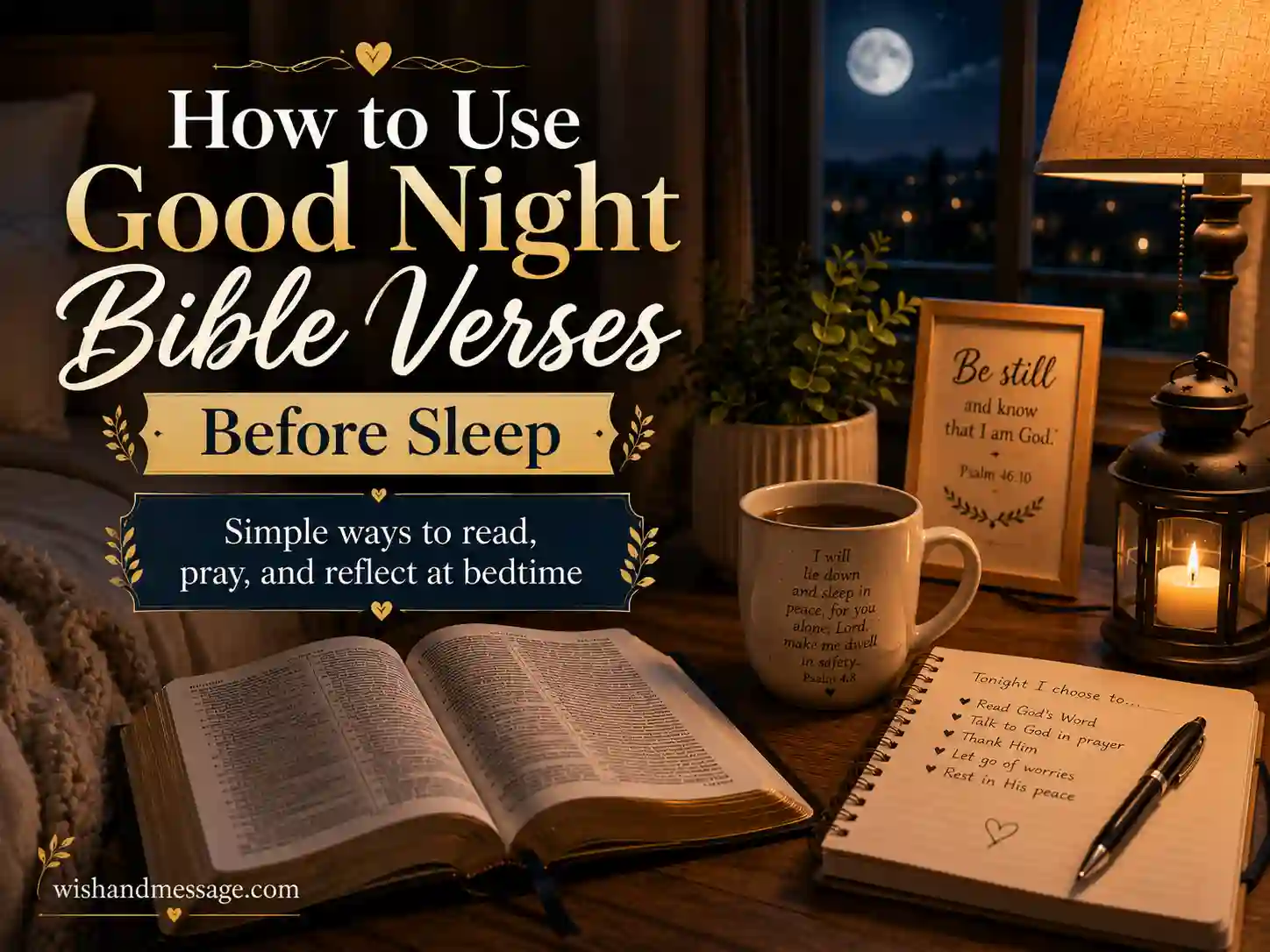
You do not need an elaborate nighttime devotional routine to make Scripture part of your evening. One carefully chosen verse can be enough. The aim is not to rush through many passages. Instead, pay attention to what the text says. Respond to God with honesty.
Read One Verse Slowly
Choose the verse that best matches what you are carrying tonight. Read it once normally, then read it again more slowly.
Notice the words that describe God, the invitation the passage gives, and the response it calls for. If one line stands out, stay with that line instead of immediately searching for another verse. A short passage remembered clearly can be more useful than a long list read quickly.
Turn the Verse Into a Short Bedtime Prayer
You can use the theme of a verse as the starting point for prayer while keeping your own words distinct from the biblical quotation.
For example, after reading 1 Peter 5:7, you might pray: “God, I am giving you the worry I keep returning to tonight. Help me trust your care and face tomorrow one step at a time.”
That example is a personal prayer inspired by the passage, not part of 1 Peter 5:7. For longer prayers when your thoughts feel heavy, explore these bedtime prayers for stressful nights.
Use One Verse With Children or Family
Family bedtime Scripture can be simple. Choose a short verse, read it together, and ask one easy question such as, “What does this verse tell us about God?”
Psalm 4:8 can work well because it connects peace, sleep and trust in God’s care. For wording to adapt to a child’s age and understanding, see these prayers to share at a child’s bedtime.
Share a Verse in a Good Night Message
When sending Scripture to someone, think about what that person needs rather than choosing a verse simply because it sounds beautiful.
Numbers 6:24-26 fits a blessing. John 14:27 fits someone who needs peace. Romans 15:13 fits a person who needs encouragement and hope.
Send the Scripture accurately, include the reference, and then add your personal message separately. That keeps God’s Word distinct while still allowing the message to feel warm and personal.
If you want to pair a passage with a ready-to-send prayer, these nighttime prayer messages to share offer wording for family, friends and someone you love.
Final Thoughts
Choose one passage rather than feeling you must read all 18 every night. Psalm 4:8 speaks about peaceful sleep, Philippians 4:6-7 gives words for prayer amid worry, and Matthew 11:28-30 invites the weary to Christ. Read the linked chapter, reflect on its meaning and respond in your own words.
Read one passage carefully. Notice what it reveals about God. Turn its theme into an honest prayer, and let the day end. Do not demand that every unanswered question be solved tonight.
For a collection centered on blessings and prayers rather than Bible quotations, browse these goodnight blessings for comfort and rest.
Frequently Asked Questions
What Psalm Is Good to Read Before Sleep?
Psalm 4 is a short choice for bedtime. Psalm 3 speaks about sleeping and waking amid distress, Psalm 23 centers on the shepherd's care, and Psalm 121 describes Israel's keeper as one who does not sleep. Read the whole Psalm when you have time.
What Bible Verse Can I Read When I Am Anxious at Night?
Philippians 4:6-7 and 1 Peter 5:7 give words for bringing worries to God in prayer. They offer spiritual encouragement, not a promised treatment or an instant end to anxious thoughts. Seek appropriate professional care when anxiety or sleep difficulties persist.
Can I Use a Bible Verse as a Bedtime Prayer?
Yes. Read the verse accurately, then respond in your own words with thanks, a request or a concern you want to entrust to God. Keep that response separate from the quoted Scripture and its reference, especially when sharing it with someone else.
What Bible Verse Can I Share in a Good Night Wish?
Numbers 6:24-26 offers a blessing of care and peace; Romans 15:13 is a prayer for joy, peace and hope. Choose a passage the recipient would welcome, include its reference and translation, then add your own greeting separately. These are Scripture passages used in a nighttime message, not verses originally written as modern goodnight texts.
Written by Najam Ul Hussain